A website can look polished and still fail to generate enquiries. That usually means the problem is not only visual. The real issue is often the way the site is structured, how clearly it answers search intent, and whether it gives visitors a reason to contact you.
If your website is getting traffic but no leads, or if visitors leave without taking action, the site is probably creating friction somewhere in the customer journey. The objective is simple: be found, be understood and generate contact.
Direct answer: what usually stops a website from generating clients?
Most websites fail to convert because they do not combine visibility, credibility and clarity. If visitors do not quickly understand what you offer, why they should trust you, and what to do next, they leave.
Table of contents
Why does a website get visitors but no clients?
Traffic alone does not create revenue. A website only generates clients when it matches the visitor’s intent and removes doubt fast enough to keep attention.
In many cases, the site attracts the wrong audience, or it attracts the right audience but fails to guide them. That is common on sites built around design preferences instead of business goals.
For example, a construction company website development project may look impressive, but if it does not show services, proof, locations and contact options clearly, it will not convert serious prospects.
The most common reasons are simple
- The value proposition is vague.
- The homepage does not explain what the company does in the first few seconds.
- Calls to action are weak, hidden or inconsistent.
- Pages load slowly on mobile.
- There is not enough trust proof, such as case studies, reviews or certifications.
- The content does not match the search intent behind the visit.
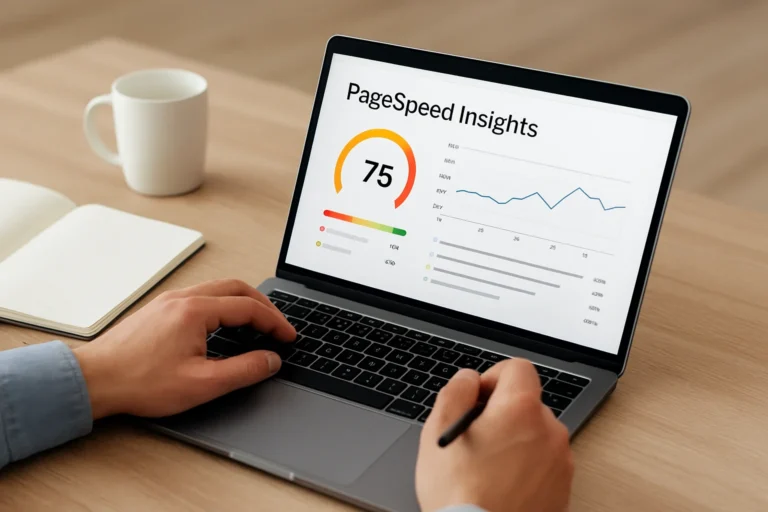
A slow website does not only create a technical problem. It creates a business problem, because visitors leave faster, Google has more difficulty crawling the pages and potential clients may lose trust before contacting the company.
What should you fix first?
Start with the parts that affect conversion most directly. Before redesigning everything, check whether the site can answer three questions quickly: what you do, who it is for, and why you are credible.
1. Clarify the offer above the fold
The first screen should explain the service in plain language. If a visitor needs to scroll to understand your offer, the page is already losing efficiency.
2. Make the next step obvious
Every important page should guide the visitor toward one action. That could be a call, a quote request, a consultation or a form. Too many options reduce conversion.
3. Strengthen trust signals
Business buyers need proof. Add client logos, testimonials, project examples, team information, service scope and clear contact details. Without trust, even good traffic does not convert.
4. Improve speed and mobile usability
Most decision-makers will review your site on a phone. If the site is hard to read, slow or cluttered, it damages credibility immediately.
For companies looking to improve visibility credibility qualified leads, the first priority is not more content. It is a cleaner site foundation that supports both search and conversion.
What does a weak website look like compared with a conversion-focused one?
| Area | Weak website | Conversion-focused website | Business impact |
|---|---|---|---|
| Message | Generic and unclear | Specific and benefit-driven | Visitors understand the offer faster |
| Navigation | Too many pages or confusing labels | Simple structure with clear paths | Less friction, more actions |
| Trust | Few proof elements | Testimonials, cases, credentials, contact details | More confidence before enquiry |
| Speed | Slow on mobile | Optimized for performance | Lower bounce rate, better SEO |
| SEO | Pages not aligned with search intent | Content structured around real questions | Better visibility and qualified traffic |
| Conversion | Weak or hidden calls to action | Clear forms and contact prompts | More leads from the same traffic |
How do SEO, GEO and AEO affect lead generation?
Search visibility is not only about ranking. It is about being present for the right queries, in the right format, with the right answer.
SEO helps your pages appear in search results. GEO helps your content stay understandable and usable by AI search systems and generative engines. AEO helps your pages answer questions directly, which matters for featured snippets, voice search and AI summaries.
That is why content should be structured clearly. A page about website development air conditioning, for example, should not only mention the service. It should explain the service area, the commercial problem it solves, and the next step for the visitor.
The same logic applies to generate applications reassure employers. If a recruitment-oriented website is built only to look modern, but does not answer candidate and employer questions clearly, it will not support lead generation or trust.
For businesses that rely on digital channels, good SEO is not just about traffic volume. It is about attracting qualified visitors who are more likely to contact you.
Why is this a business problem, not only a web issue?
When a website fails to convert, the company pays twice. First, it pays for traffic that does not produce results. Then it loses opportunities because prospects choose a competitor with a clearer message and stronger credibility.
This affects commercial performance in several ways:
- lower lead volume from the same marketing budget;
- higher acquisition cost per client;
- weaker trust during the first interaction;
- missed opportunities from organic search;
- reduced return on content, ads and social media.
In other words, the site is not just a digital asset. It is part of the sales process. If it does not support that process, it limits growth.
This is especially true for sectors where buyers compare several providers before contacting anyone. A learning platform website development project, for example, must do more than present courses. It must show outcomes, audience fit, proof and a clear enrolment path.
What should you do first if your website is not generating clients?
Step 1: Review the homepage message
Check whether a new visitor can understand your offer in less than 10 seconds. If not, rewrite the headline, subheadline and main call to action.
Step 2: Analyse the main conversion pages
Look at service pages, contact pages and landing pages. Ask whether they answer the real objections a buyer may have: price, process, timeline, credibility and fit.
Step 3: Check technical performance
Review mobile speed, Core Web Vitals, broken links, form issues and page structure. Technical weaknesses often reduce both rankings and conversions.
Step 4: Align content with search intent
Each page should target one clear intent. Informational pages should educate. Service pages should convert. Local pages should support local visibility. Mixing everything into one page weakens performance.
Step 5: Add proof and friction reducers
Use testimonials, case studies, FAQs, pricing signals when appropriate, and simple contact options. The more confident the visitor feels, the more likely they are to act.
Where THE ROAD fits into this process
Chez THE ROAD, l’objectif n’est pas seulement de créer un site web visuellement propre. L’objectif est de construire une présence digitale claire, rapide, crédible et capable de soutenir la croissance de l’entreprise.
That means working on the full chain: website creation, redesign, maintenance, SEO, GEO, AEO and conversion structure. For some companies, the right answer is a full rebuild. For others, it is a targeted optimisation of the pages that matter most.
The point is not to add more design. The point is to improve the site so it supports visibility, trust and qualified leads.
FAQ
Why is my website getting traffic but no leads?
Usually because the traffic is not qualified, the message is unclear, or the site does not build enough trust. A visitor needs a clear reason to stay and a simple next step to take.
Should I redesign the whole website?
Not always. Sometimes the issue is only the homepage, service pages or forms. A proper audit helps identify whether a full redesign or a focused fix is the better investment.
Does SEO alone generate clients?
No. SEO brings visibility, but the site must also convert. If the content, structure and trust signals are weak, ranking alone will not produce enough enquiries.
How fast can results improve?
Some conversion fixes can improve performance quickly, especially on high-traffic pages. SEO and GEO changes usually take longer, but they create stronger long-term growth.
When should I contact an agency?
If your website receives visits but no enquiries, if your bounce rate is high, or if your competitors look more credible online, it is time to review the site with a professional team.
Conclusion: a website must do more than exist
A website that does not generate clients is usually missing one of three things: visibility, credibility or conversion clarity. Fixing that problem requires more than a visual refresh. It requires a business-focused approach to structure, content, performance and search intent.
If you want a website that supports commercial performance instead of just looking active, THE ROAD can help you identify what is blocking results and what should be improved first.
You have a web project, a redesign or an SEO need? THE ROAD can support you with a clear, professional and results-oriented approach.