A website does not rank because it has more pages. It ranks because Google understands what the company is about, which problems it solves, and how its content is connected.
The real challenge is not only publishing articles. It is organizing them around one offer so the website becomes clearer for users, easier to crawl, and stronger for conversion.
What is a semantic cluster, and why does it matter for business?
A semantic cluster is a group of pages and articles built around one main offer, one commercial intent, and several related questions. The goal is to cover a topic deeply enough that search engines can understand the company’s expertise.
For a business, this is not just an SEO method. It is a way to structure the website so visitors find the right information faster and move more naturally toward contact, quote request, or purchase.
When the structure is weak, content becomes scattered. The same topic is repeated across pages, internal links are random, and the website sends mixed signals. That reduces visibility, credibility, and often conversion.
How does a semantic cluster work in practice?
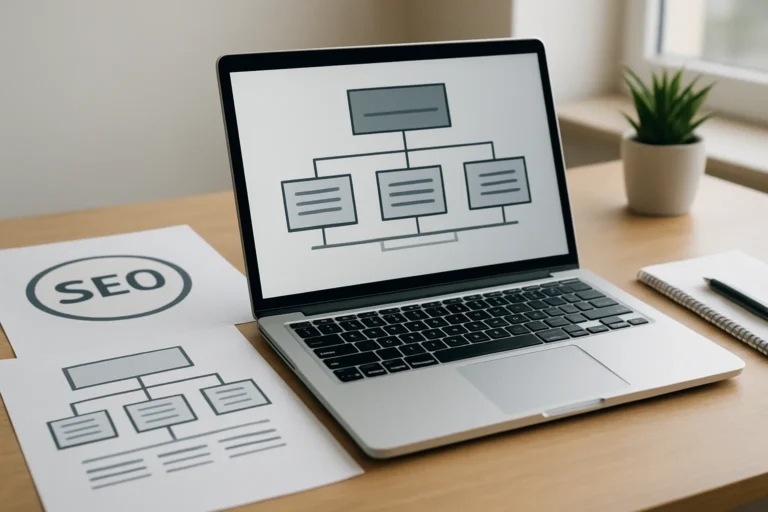
The model starts with one central page, usually the main service or offer page. Around it, you build supporting content that answers specific questions, objections, use cases, and comparison points related to that offer.
The central page targets the main commercial search intent. The supporting pages target informational and decision-stage queries. Together, they create a clear topical map.
Typical structure of a cluster
- One pillar page focused on the main offer
- Several supporting articles answering related questions
- Internal links connecting every page to the main offer
- Clear headings that reflect search intent
- Consistent terminology across the whole cluster
This structure helps both users and search engines. Users get a logical reading path. Search engines get stronger context and better topical relevance.
What pages should be included around one offer?
The right pages depend on the offer, the market, and the sales cycle. A simple service may need only a few supporting pages. A more competitive offer may need a larger cluster with educational, comparison, and conversion-focused content.
| Page type | Purpose | Business impact |
|---|---|---|
| Main service page | Explains the offer and targets the primary keyword | Drives qualified leads and conversion |
| How it works page | Explains the process, steps, and deliverables | Reduces friction and improves trust |
| Use case page | Shows how the offer applies to a specific sector | Improves relevance for niche searches |
| FAQ page or section | Answers common objections and questions | Supports AEO and reduces sales hesitation |
| Comparison page | Compares options, tools, or approaches | Helps decision-makers choose faster |
For example, a company offering construction company website development should not rely on one generic service page. It should also cover project structure, lead generation, trust signals, and sector-specific needs.
The same logic applies to learning platform website development, recruitment agency website development, and psychologist website development Tunisia. Each offer needs its own content ecosystem, not a single isolated page.
How do you choose the right pillar page?
The pillar page is the commercial center of the cluster. It should represent the main offer you want to rank for and convert on.
A good pillar page does three things well: it explains the service clearly, it proves relevance, and it gives visitors a reason to contact the company.
What the pillar page must include
- A clear definition of the offer
- The business problem it solves
- The process and deliverables
- Proof of expertise and trust
- Internal links to supporting content
- A direct call to action
If the pillar page is vague, the whole cluster becomes weaker. If it is too broad, it attracts the wrong traffic. The objective is simple: be found, be understood, and generate contact.
What should supporting content answer?
Supporting pages should not repeat the service page. They should answer the questions a buyer asks before making a decision.
That usually includes cost, timeline, risks, process, comparison, maintenance, and results. These pages help capture search intent at different stages of the buying journey.
Examples of useful supporting angles
- How much does the service cost?
- What should be included in the project?
- What mistakes should be avoided?
- How long does implementation take?
- What makes a professional solution different?
This is where SEO and business strategy meet. A well-written support page can answer objections before a sales call even happens.
How should internal linking be organized?
Internal linking is what gives the cluster its structure. Without it, the pages may exist, but they do not work as a system.
Each supporting page should link back to the pillar page using natural anchor text. The pillar page should also link to the most relevant supporting pages. This creates a clear hierarchy and reinforces the main topic.
A good linking structure also helps distribute authority across the cluster. That improves crawl efficiency and makes it easier for Google to understand which page should rank for which intent.
What is the difference between a content cluster and random blog publishing?
| Random publishing | Semantic cluster |
|---|---|
| Articles are published without a clear structure | Content is organized around one offer and one intent |
| Topics overlap and compete with each other | Each page has a defined role |
| Internal links are inconsistent | Links strengthen the main service page |
| Traffic may grow without leads | Traffic is designed to support conversion |
| Search engines see scattered signals | Search engines see topical authority |
The difference is not cosmetic. A structured cluster supports long-term SEO, content efficiency, and commercial performance.
How do SEO, GEO, and AEO fit into the cluster model?
A semantic cluster is useful for classic SEO, but it is also strong for GEO and AEO because the structure is easier for machines to interpret.
Search engines and AI systems prefer content that is clearly organized, specific, and connected. A cluster gives them context, hierarchy, and direct answers.
Why this matters for AI search visibility
When pages are written with clear headings, concise answers, and strong topical relationships, they are easier to cite, summarize, and surface in AI-driven results.
That is especially important for companies competing on expertise. A clean structure improves the chance that your content is understood as a reliable source rather than just another generic page.
For businesses that need local visibility or niche authority, this approach is often more effective than publishing isolated articles with no strategic connection.
What is the best way to build a cluster around one offer?
The process should start with strategy, not writing. First define the offer, the target audience, the main keyword, and the commercial objective. Then map the questions users ask before they contact a provider.
Step-by-step approach
- Define the offer and its primary search intent
- Identify the main pillar page
- List the supporting questions and subtopics
- Group topics by intent: information, comparison, decision
- Write each page with one clear purpose
- Connect pages with internal links
- Review performance and refine the cluster over time
This method avoids duplication and keeps the content aligned with business goals. It also makes future expansion easier because every new page has a place in the structure.
How does a semantic cluster improve conversion?
Better structure improves conversion because it reduces confusion. Visitors understand what the company offers, how it works, and why it is relevant to their needs.
It also creates more trust. A website that answers questions clearly feels more credible than one that only repeats sales claims.
For decision-makers, that matters. A well-built cluster shortens the path from search to contact because it removes uncertainty at each step.
Chez THE ROAD, l’objectif n’est pas seulement de créer un site web visuellement propre. L’objectif est de construire une présence digitale claire, rapide, crédible et capable de soutenir la croissance de l’entreprise.
When should a company contact an agency?
A company should consider professional support when content is growing without structure, when service pages are not ranking, or when traffic is not turning into leads.
It is also the right moment when a business is launching a new offer, entering a competitive market, or planning a redesign. SEO should not be added after the website is finished. It should be planned from the beginning.
At THE ROAD, we help companies build websites and content structures that support visibility, credibility, SEO, GEO, AEO, and conversion. The goal is not volume for its own sake. The goal is a website that works like a business asset.
FAQ
What is a semantic cluster?
A semantic cluster is a group of pages organized around one main offer and related subtopics. It helps search engines understand your expertise and helps users find the right information faster.
How many pages should a cluster include?
There is no fixed number. A simple offer may need a pillar page and 3 to 5 supporting pages. More competitive markets usually need a larger structure based on search intent and business goals.
Does a semantic cluster help with leads?
Yes. It improves clarity, trust, and relevance. That makes it easier for visitors to understand the offer and contact the company with more confidence.
Is this useful for local businesses?
Yes. A cluster can improve local visibility by covering service intent, location intent, and sector-specific needs in a structured way.
Can one page rank without a cluster?
Sometimes, but it is harder to build authority and maintain long-term performance. A cluster gives the page stronger context and better support from related content.
Build content that supports the offer, not just the website
A semantic cluster is not a content trend. It is a practical way to organize a website so it can rank, explain, and convert more effectively.
If your website needs a clearer structure, stronger topical authority, or a content plan built around business goals, THE ROAD can help you design it properly.
You have a web project, a redesign, or an SEO need? THE ROAD can support you with a clear, professional approach focused on results.