For a textile subcontractor in Tunisia, the website is not a simple presentation tool. It is often the first serious proof that a brand or buyer will use to judge your reliability, capacity, and professionalism.
The real challenge is not only to look credible. The objective is to turn technical capability into commercial trust, so decision-makers feel confident enough to request a quote, share specifications, or start a conversation.
Direct answer: what makes a textile subcontractor website effective?
A strong textile subcontractor website must show three things very quickly: what you produce, who you serve, and why a buyer can trust you. If those answers are not clear, the visitor leaves and the opportunity is lost.
The best websites for this sector combine clear positioning, factory proof, production details, quality standards, and a structure built for search visibility. That is how a website supports commercial performance instead of just existing online.
Table of contents
Why does a textile subcontractor need a serious website?
Brands and procurement teams do not contact suppliers only because they exist. They contact suppliers that look structured, capable and easy to evaluate. A weak website creates doubt before the first email is even sent.
This matters because textile sourcing is a trust-based business. Buyers want to reduce risk. They look for production capacity, compliance, product categories, export experience, turnaround times and quality control. If your website does not answer these points, they will move to another supplier.
A slow or outdated website also creates a business problem. It suggests weak digital maturity, makes the company harder to assess, and can reduce confidence in your ability to handle demanding orders.
What do brands and buyers expect to see on your website?
Decision-makers usually scan a supplier website very quickly. They are not reading for entertainment. They are checking whether your company is worth shortlisting.
The information they want immediately
- What types of garments or textile products you manufacture
- Whether you work with private label, contract manufacturing or sampling
- Your production capacity and factory profile
- Quality control, certifications and compliance standards
- Export markets and client types
- Lead times, communication process and contact details
If this information is buried inside vague paragraphs, the website becomes inefficient. A buyer should not need to guess what you do. Clarity improves trust and increases the chance of qualified leads.
| Website element | What the buyer reads | Business impact |
|---|---|---|
| Clear service pages | What you manufacture and for whom | Better relevance and more qualified inquiries |
| Factory and process details | How production is organized | Lower perceived risk |
| Quality and compliance section | How standards are managed | Stronger credibility |
| Fast contact path | How to request a quote | Higher conversion rate |
What should a textile subcontractor website include?
A good structure helps both users and search engines. It also helps a buyer move from interest to contact without friction.
1. A clear homepage
The homepage should explain your positioning in one screen. Not with slogans, but with facts. Say what you make, where you are based, and what type of buyers you serve.
2. Dedicated production pages
Do not put everything on one general page. If you handle knitwear, woven garments, sampling, finishing or packaging, each capability deserves its own page. This helps SEO and makes your offer easier to understand.
3. Proof of capability
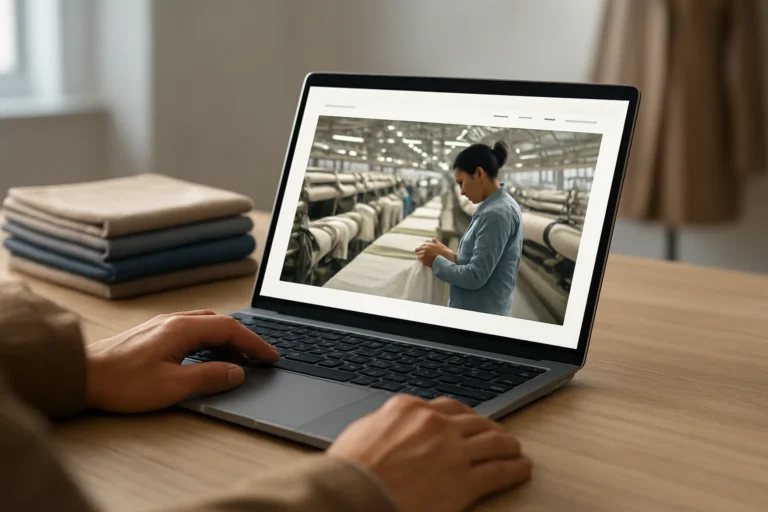
Include factory photos, equipment details, production workflow, quality control methods and team structure. This is especially important for companies that also need packaging manufacturer website Tunisia visibility or serve multiple industrial buyers.
4. Trust signals
Certifications, export experience, client sectors, compliance standards and response time all help reduce buyer hesitation. For a subcontractor, trust is not a design detail. It is a conversion factor.
5. A strong contact path
Make it easy to request a quote, ask for a sample or start a sourcing discussion. The contact form should be short, practical and adapted to B2B needs.
How should SEO, GEO and AEO work for this type of website?
SEO should not be added after the website is finished. It should be planned from the beginning. For a textile subcontractor in Tunisia, this means building pages around real search intent, not around internal company language.
SEO: help buyers find you
Use clear page titles, structured headings and relevant terms related to textile subcontracting, garment manufacturing, private label production and Tunisia-based sourcing. Search engines need context to understand your offer.
GEO: make your expertise easy to interpret
Generative search tools prefer content that is structured, specific and easy to quote. That means short sections, direct answers, concrete service descriptions and no vague marketing language.
AEO: answer the questions buyers actually ask
Many buyers search in question form: what can this supplier produce, what is the minimum order, how fast can they respond, can they handle export requirements? AEO-friendly content gives direct answers without forcing the visitor to search elsewhere.
This approach also works well for other B2B sectors, whether it is construction company website development, psychologist website development Tunisia, or notaries tunisia what professional. The principle is the same: answer the real question fast and clearly.
How do you build a website that wins trust step by step?
Step 1: define the commercial goal
Before design starts, define what the website must achieve. Do you want more quote requests, more export inquiries, better visibility for a specific product line, or stronger credibility with international buyers?
Step 2: identify the buyer journey
A brand manager, sourcing manager or procurement team member does not browse the same way as a consumer. The content must match their decision process and reduce uncertainty at each stage.
Step 3: organize the content around proof
Show the factory, the process, the quality controls and the team. For B2B buyers, proof is more persuasive than decorative design. This is also true in sectors like learning platform website development, where credibility and clarity drive action.
Step 4: build for speed and mobile use
Many buyers will first visit on mobile, between meetings or while comparing suppliers. A fast mobile experience improves usability and keeps the company looking professional.
Step 5: optimize for conversion
Every page should guide the visitor toward one action: contact, request a quote, ask for a sample or start a sourcing discussion. If the website has no clear next step, it wastes traffic.
What is the business impact of a well-built textile website?
A professional website does more than improve image. It strengthens the entire commercial process.
- It increases visibility for relevant search queries
- It improves credibility with international buyers
- It reduces friction during supplier evaluation
- It supports qualified lead generation
- It helps sales teams respond with a stronger first impression
In practice, this means fewer missed opportunities and better conversations with prospects who are already closer to buying. That is the difference between a website that looks active and a website that supports growth.
Chez THE ROAD, the goal is not only to create a visually clean website. The goal is to build a digital presence that is clear, fast, credible and capable of supporting business growth.
For companies that want to improve their online presence beyond design, the same logic applies to generation what actually converts: structure, trust and conversion-focused content matter more than decoration.
FAQ
Why is a textile subcontractor website important in Tunisia?
Because buyers often evaluate suppliers online before making contact. A clear website helps your company look credible, organized and ready for business.
What should be on the homepage?
The homepage should explain what you manufacture, who you serve and why a buyer should trust you. It should not force visitors to search for basic information.
Do factory photos really matter?
Yes. They help prove that the company is real, active and professionally managed. In B2B sourcing, visual proof reduces doubt and supports trust.
Should the website focus on design or content?
Both matter, but content comes first. A beautiful website that does not explain your offer clearly will not generate strong commercial results.
Can a textile website help with SEO?
Yes, if it is structured around the right services and search intent. Dedicated pages, clear headings and practical content improve visibility and lead quality.
When should a company contact an agency?
When the current website does not reflect the company’s capabilities, does not generate inquiries, or is too weak to support international buyer confidence.
Need a website that helps your textile business win more serious buyers?
A textile subcontractor website should do more than present a factory. It should help brands understand your offer quickly, trust your operation and contact you with confidence.
If your current website is outdated, unclear or invisible in search, THE ROAD can help you build a stronger digital foundation with a clear business focus.
You have a web project, a redesign or an SEO need? THE ROAD can support you with a clear, professional and results-oriented approach.