A medical equipment supplier website has one main business goal: help healthcare buyers understand your offer quickly and request a quote with confidence. If the site is unclear, slow, or incomplete, potential clients move on to another supplier without contacting you.
The real problem is not only the design. It is the commercial impact of poor structure, weak product presentation, and missing trust signals. A well-built website must support visibility, credibility, and conversion at the same time.
Direct answer: what should a medical equipment website do?
A professional medical equipment website should present your products in a clear technical format, explain your areas of supply, and make it easy for hospitals, clinics, distributors, and procurement teams to request a quote.
For a supplier in Tunisia, the website should also support local visibility, multilingual communication if needed, and a strong lead-generation flow. The objective is simple: be found, be understood, and generate contact.
Table of contents
- Why your website matters for medical equipment sales
- What information should be shown on product pages?
- How to turn product visits into quote requests
- Which trust signals matter most in this sector?
- SEO, GEO and AEO for medical equipment suppliers
- How a professional website project should be built
- Business impact: visibility, leads and sales efficiency
- FAQ
- Conclusion and next step
Why does a medical equipment supplier need a strong website?
Buyers in this sector do not browse casually. They compare specifications, compatibility, certifications, availability, and after-sales support before they contact a supplier. If your website does not answer those questions quickly, it weakens your commercial position.
A good website gives structure to your offer. It helps visitors understand whether you supply diagnostic devices, hospital furniture, consumables, sterilization equipment, laboratory tools, or rehabilitation products. That clarity reduces friction and improves lead quality.
It also supports your sales team. When product information is organized properly, requests become more relevant, and your team spends less time explaining basic details. That is why a website is not just a marketing tool. It is part of the sales process.
What should product pages include?
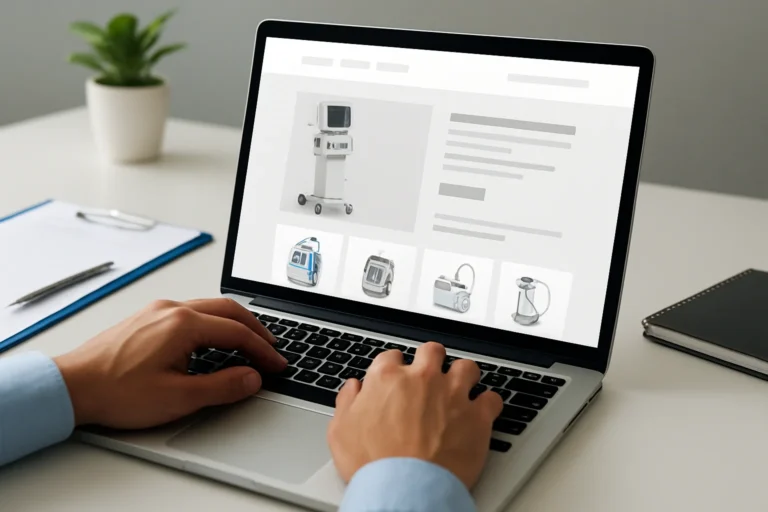
Product pages should be built for decision-makers, not just for browsing. A visitor should be able to understand the product, its use, and its business value within a few seconds.
Essential content for each product page
- Product name and category
- Clear description of use and target environment
- Technical specifications
- Available models or variants
- Compatibility or accessories
- Certifications or compliance references when relevant
- Availability and delivery information
- Call to action for quote or consultation
For some suppliers, product pages also need downloadable brochures or datasheets. This is useful for procurement teams that need to share information internally before approving a request.
| Page element | Business value | Risk if missing |
|---|---|---|
| Technical specs | Builds confidence and saves sales time | Visitors leave to find clearer information elsewhere |
| Quote form | Captures qualified leads | Interest is lost before contact |
| Use cases | Helps buyers see relevance | The product feels generic |
| Compliance details | Supports trust and procurement review | Questions increase and conversion drops |
How do you turn product interest into quote requests?
The conversion path must be short and clear. If a visitor has to search for contact details, open several pages, or fill in a long form, the probability of losing the lead increases.
A strong quote flow should appear naturally on product pages, category pages, and key landing pages. The form should ask for the right information without creating friction.
A practical quote request structure
- The visitor views a product or category page.
- They see a clear call to action such as request a quote or ask for availability.
- The form asks for name, company, email, phone, product of interest, and project details.
- The request is sent to the right sales contact or department.
- The company replies quickly with a relevant commercial response.
This is where generation what actually converts becomes important. A form should not collect random data. It should collect the information your sales team needs to answer efficiently and close the opportunity.
Which trust signals matter most in this sector?
Medical equipment is a trust-sensitive market. Buyers want to know that they are dealing with a serious supplier, not a generic reseller. The website must therefore reduce doubt at every stage.
Trust signals that improve credibility
- Company profile with clear positioning
- Sector expertise and product categories
- Client references or sectors served, when allowed
- After-sales support and maintenance information
- Warranty or service commitment details
- Contact information that is easy to verify
These elements matter because they influence both perceived reliability and procurement confidence. A buyer may not contact you if the site feels incomplete or outdated, even if your offer is strong.
This is also where a professional structure helps. In projects similar to construction company website development or psychologist website development tunisia, the same principle applies: the site must reduce hesitation and make the next action obvious.
How should SEO, GEO and AEO be handled for this type of website?
SEO helps your pages appear in Google when buyers search for products, suppliers, or medical equipment categories. GEO helps your content stay understandable for AI search systems. AEO helps the site answer direct questions clearly and quickly.
For a supplier in Tunisia, that means organizing content around search intent, not just around internal company logic. A visitor may search by product type, use case, or supplier location. Your structure should reflect that.
What to optimize
- Category pages for broad product searches
- Product pages for specific models and technical terms
- Service pages for installation, maintenance, or supply support
- FAQ blocks for direct questions buyers ask before requesting a quote
Content should be written in clear language and supported by a solid technical foundation. Fast loading, clean navigation, mobile usability, and proper indexing all affect visibility and lead generation.
For businesses exploring learning platform website development or notaries tunisia what professional, the same search logic applies: clear answers, structured pages, and strong local relevance improve discovery.
How should a professional website project be built?
A medical equipment website should not start with visual design alone. It should start with business goals, product structure, and lead flow. That approach avoids confusion later and makes the final site easier to manage.
Step 1: Define the commercial structure
List your product categories, priority services, and target audiences. A supplier serving hospitals does not need the same structure as a company focused on clinics or laboratories.
Step 2: Build the content architecture
Decide how products will be grouped, how quote requests will work, and which pages are needed for trust and SEO.
Step 3: Design for clarity
The interface should support quick reading on mobile, clear calls to action, and easy access to product information.
Step 4: Develop for performance
Speed, security, and technical stability matter. A slow website does not only create a technical problem. It creates a business problem, because visitors leave faster, Google has more difficulty crawling the pages and potential clients may lose trust before contacting the company.
Step 5: Launch with SEO and tracking
The site should be ready for indexing, analytics, form tracking, and future content growth from day one.
What is the business impact of a well-built medical equipment website?
A strong website improves more than online presence. It improves sales efficiency, lead quality, and market credibility. That is especially important in a sector where buyers compare several suppliers before making contact.
| Weak website | Professional website | Business impact |
|---|---|---|
| Unclear product pages | Structured technical presentation | More qualified inquiries |
| Hidden contact options | Visible quote forms and calls to action | Higher conversion rate |
| Little trust content | Clear company and service information | More confidence from buyers |
| Poor SEO structure | Pages built around search intent | Better visibility and more traffic |
In practical terms, a better website can reduce wasted sales time, improve the quality of incoming requests, and support long-term SEO. That is why companies often compare efficiency insight compare perspective before choosing between a basic website and a more strategic build.
Why work with THE ROAD?
Chez THE ROAD, l’objectif n’est pas seulement de créer un site web visuellement propre. L’objectif est de construire une présence digitale claire, rapide, crédible et capable de soutenir la croissance de l’entreprise.
For a medical equipment supplier in Tunisia, that means a website built to present products properly, support local visibility, and generate quote requests without unnecessary friction. It also means planning SEO, GEO, and conversion from the beginning, not after launch.
FAQ
What is the most important page on a medical equipment website?
Product and category pages are usually the most important. They must explain the offer clearly and guide the visitor toward a quote request. If those pages are weak, the rest of the site will underperform.
Should the website include a price list?
Not always. In many B2B cases, quote-based sales are more realistic because prices depend on quantity, configuration, and service scope. A request form is often more effective than fixed prices.
Do medical equipment websites need SEO?
Yes. Buyers search for specific products, suppliers, and service terms. Without SEO, your site depends too much on direct traffic and referrals, which limits growth.
Can a website help reduce unqualified inquiries?
Yes. Clear product descriptions, target audience details, and structured forms help filter requests. This saves time for the sales team and improves lead quality.
How long does it take to build this type of website?
The timeline depends on the number of products, content volume, and required features. A strategic project usually takes longer than a basic brochure site because the structure must support both SEO and conversion.
Conclusion: a website should support sales, not just display products
A medical equipment supplier website in Tunisia should help visitors understand your offer quickly, trust your company, and request a quote without friction. When the structure is clear and the content is built for search intent, the site becomes a real commercial asset.
If you want a website that presents your equipment professionally and generates qualified inquiries, THE ROAD can help with strategy, design, development, SEO, GEO, and conversion-focused structure.
You have a web project, a redesign, or an SEO need? THE ROAD can support you with a clear, professional, and results-oriented approach.