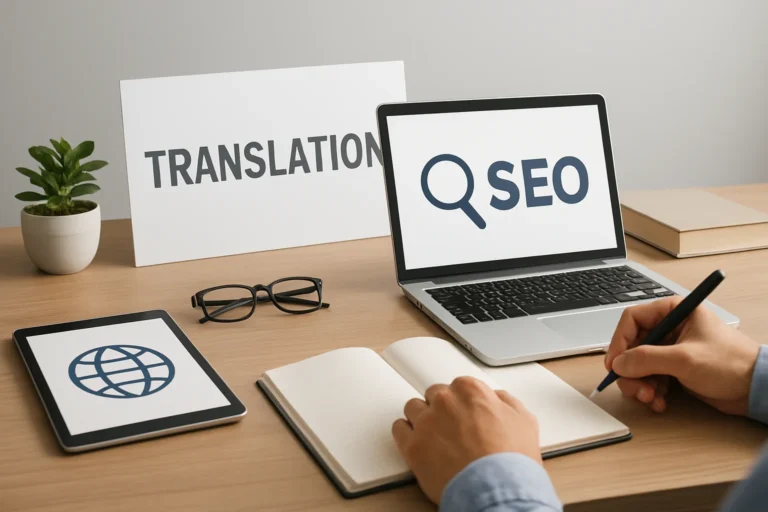
A translation agency does not win online visibility by listing languages only. The real challenge is to appear for the right search intent: legal translation, certified translation, technical translation, interpretation, and urgent business requests.
If the website is built around generic pages, Google and AI search tools struggle to understand what the agency really offers. That weakens visibility, reduces qualified leads, and makes the business easier to ignore.
Direct answer: what should a translation agency in Tunisia optimize first?
The first priority is not more content. It is a clear SEO structure built around language pairs, service specializations, and high-intent professional requests. A translation agency should create pages that match how clients actually search: by language, document type, industry, and urgency.
That means building separate landing pages for core services, defining the languages that matter commercially, and making every page easy to crawl, easy to understand, and easy to contact from.
Table of contents
Why does SEO matter so much for a translation agency?
Translation services are often searched with a very specific intent. A client does not usually search for a general agency first. They search for a solution to a precise need: sworn translation, website localization, legal documents, medical content, or business communication in another language.
If the website does not reflect those needs, the agency loses relevance. The visitor may still need the service, but they will choose a competitor whose pages feel more specific and more credible.
This is why SEO for a translation agency is not only about ranking. It is about matching the search intent with the right offer, the right language, and the right proof of expertise.
Which languages and specialties should be targeted?
A translation agency in Tunisia should not try to rank for every possible language combination at once. The better approach is to focus on the combinations that have real commercial demand and clear business value.
Languages that usually deserve dedicated pages
- Arabic to French and French to Arabic
- English to French and French to English
- Italian, German, Spanish, and other business-relevant pairs
- Specialized combinations for export, legal, or technical sectors
Specialties that attract professional demand
- Legal and certified translation
- Technical and industrial translation
- Medical and pharmaceutical translation
- Website and marketing localization
- Business documents, contracts, and tenders
- Interpretation for meetings and events
The best pages are not built around abstract keywords. They are built around real use cases. For example, a company searching for processes materials production capacity may need precise technical translation for industrial documentation. A legal office may need content aligned with notaries tunisia what professional requirements. A training company may need multilingual content similar to learning platform website development use cases.
That specificity helps search engines understand the page and helps clients trust the agency faster.
How should the website be structured for SEO?
A good structure helps both users and search engines. For a translation agency, the website should not be a single service page with a long list of languages. It should be organized by intent.
| Page type | Purpose | Business impact |
|---|---|---|
| Homepage | Explain the agency, positioning, and main services | Builds trust quickly and directs visitors to the right page |
| Service pages | One page per main service: sworn translation, localization, interpretation | Improves relevance and conversion |
| Language pages | Dedicated pages for high-demand language pairs | Captures specific search queries with stronger intent |
| Industry pages | Pages for legal, medical, technical, and commercial sectors | Shows expertise and attracts qualified leads |
| Contact page | Simple request form, quote request, and response expectations | Reduces friction and increases inquiries |
This structure also supports internal linking. A visitor who arrives on a language page should easily reach the relevant specialty page and then the contact form. That is how SEO becomes commercial performance, not just traffic.
How do SEO, GEO, and AEO work together for this type of website?
For a translation agency, SEO is no longer enough on its own. Search engines and AI assistants now need clear, structured, and trustworthy content that they can summarize confidently.
SEO: ranking for the right searches
Traditional SEO helps the agency appear for service and language-related queries. The goal is to rank for terms that reflect real demand, not vanity traffic.
GEO: making content understandable for AI search
GEO, or generative engine optimization, means writing in a way that AI systems can interpret easily. Short sections, precise headings, direct answers, and clear service definitions improve the chances of being cited or summarized correctly.
AEO: answering questions directly
AEO, or answer engine optimization, matters because many users now ask questions instead of typing short keywords. Pages should answer things like: which documents can be translated, how fast a quote is delivered, whether certified translation is available, and which languages are supported.
For agencies that want to strengthen reliability information used by search engines and AI tools, clarity matters more than volume. The content must be factual, specific, and easy to verify.
What is the right SEO process for a translation agency?
The process should be simple, but it must be disciplined. SEO should not be added after the website is finished. It should be planned from the beginning.
Step 1: Define the commercial priorities
Start with the services that generate the best margins and the strongest demand. Not every language or specialty deserves the same visibility effort.
Step 2: Map search intent
Group keywords by intent: urgent request, certified document, industry-specific translation, or long-term business support. This prevents the site from mixing unrelated topics on the same page.
Step 3: Build dedicated landing pages
Create pages for each priority service and language combination. Each page should have a clear title, a practical explanation, proof of expertise, and a strong call to action.
Step 4: Add trust signals
Clients want to know who translates, how quality is controlled, and how sensitive documents are handled. Include process details, turnaround expectations, confidentiality standards, and sector experience.
Step 5: Optimize for conversion
A page can rank well and still fail commercially if the contact path is weak. The request form should be short, visible, and adapted to business users who want a fast response.
What is the business impact of a better SEO strategy?
A translation agency that targets the right languages and specialties does more than improve rankings. It improves lead quality.
That means fewer irrelevant requests, more professional inquiries, better trust from corporate clients, and a stronger position in competitive markets. For agencies working with legal firms, exporters, manufacturers, or international organizations, this can directly influence revenue.
A slow or vague website creates a business problem. Visitors leave faster, Google has more difficulty understanding the offer, and potential clients may move to a competitor before sending a request. The website must therefore support credibility from the first click.
For agencies that also serve sectors such as development tunisia presenting analyses or construction company website development, the same principle applies: the message must match the client’s professional context, not just the language itself.
How THE ROAD approaches SEO for translation agencies
Chez THE ROAD, l’objectif n’est pas seulement de créer un site web visuellement propre. L’objectif est de construire une présence digitale claire, rapide, crédible et capable de soutenir la croissance de l’entreprise.
For a translation agency, that means designing the site around real search intent, structuring the content for SEO and AI visibility, and making the contact path simple for business clients. The result is a website that works as a commercial tool, not just a presentation page.
FAQ
Should a translation agency create one page for all languages?
No. One generic page usually performs poorly because it mixes different intents. Dedicated pages for priority languages and services are easier to rank and convert.
What matters more: language pages or service pages?
Both matter. Service pages explain what the agency does, while language pages capture specific searches. The best structure combines both.
Can a small translation agency still compete in SEO?
Yes, if it focuses on a clear niche. Smaller agencies often win by targeting specific language pairs, sectors, and local business needs instead of broad generic keywords.
How does SEO help with qualified leads?
It brings visitors who already know what they need. That usually means better inquiries, less wasted time, and a higher chance of conversion.
When should a translation agency contact an SEO agency?
As soon as the website needs to generate leads, not just display information. SEO is more effective when it is planned before or during website creation or redesign.
Conclusion
For a translation agency in Tunisia, SEO is not about being visible for everything. It is about being visible for the right languages, the right specialties, and the right professional requests.
A clear structure, strong search intent alignment, and credible content can turn a website into a real business asset. If you want a site that supports visibility, trust, and conversion, the strategy must be built with business goals in mind from day one.
You have a web project, a redesign, or an SEO need? THE ROAD can support you with a clear, professional approach focused on results.