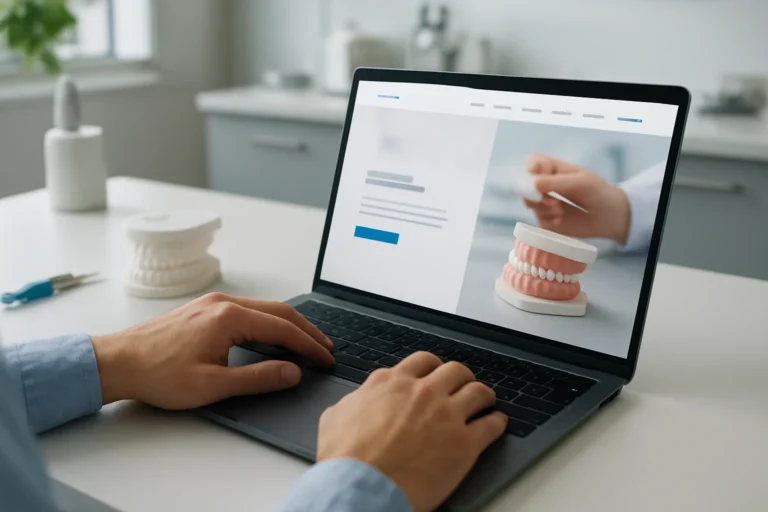
A dental laboratory does not win more business only by being technically good. It wins when dental clinics can quickly understand its reliability, production capacity, turnaround times, and communication standards.
The real problem is not only the design. A website for a dental lab must support business development, because dentists and clinic managers need clear information before they decide to work with a partner.
Direct answer: what should a dental lab website do?
A professional dental lab website in Tunisia should make it easy for dental clinics to evaluate the laboratory, trust its process, and contact the team with confidence. Its role is to support visibility, credibility, and conversion.
In practice, the website should explain services, materials, workflows, quality standards, and contact options in a way that is simple, fast, and professional. It should also help the lab appear in search results when clinics look for a reliable partner.
Table of contents
- Why do dental clinics check a website before contacting a lab?
- What information do clinics expect to find?
- How does a website build trust and business relations?
- Which features matter most for a dental lab website?
- How should SEO, GEO and AEO be handled?
- What is the right step-by-step approach?
- What is the business impact for laboratories in Tunisia?
- FAQ
Why do dental clinics check a website before contacting a lab?
Dental clinics are not looking for entertainment. They are looking for proof. Before sending cases or starting a partnership, they want to know whether the laboratory is organized, responsive, and capable of delivering consistent work.
A website is often the first filter. If the site looks outdated, vague, or incomplete, the clinic may assume the same about the laboratory’s operations. That is a business risk, not just a visual issue.
For a lab, the website becomes part of the sales process. It can reduce hesitation, answer basic questions early, and support the first contact with a more professional impression.
What information do clinics expect to find?
Dental clinics usually want practical information, not long marketing text. They want to understand what the lab does, how it works, and why it is a safe partner.
The most useful content includes:
- Types of prosthetics and restorations offered
- Materials used and quality standards
- Turnaround times and delivery process
- Digital workflow or impression handling
- Contact details and response channels
- Team expertise and laboratory experience
If this information is missing, the clinic has to ask more questions manually. That slows down the sales cycle and weakens the first impression.
How does a website build trust and business relations?
Trust in B2B healthcare is built on clarity. A dental clinic wants to work with a lab that looks stable, precise, and easy to communicate with. A website can reinforce that perception when it is structured properly.
Good content helps the clinic understand the laboratory’s process. Clear service pages, precise wording, and a professional presentation reduce uncertainty. This is especially important when the lab wants to develop long-term relationships rather than one-time orders.
A well-built website can also strengthen reliability information used by decision-makers. When the site explains production methods, coordination steps, and quality control, it gives the clinic a reason to move forward.
| Website element | Business effect | Risk if missing |
|---|---|---|
| Clear service pages | Faster understanding of capabilities | Clinics leave without contacting |
| Professional visuals and structure | Stronger credibility | Low trust and weak positioning |
| Fast contact options | More qualified inquiries | Lost opportunities |
| Technical explanations | Better alignment with clinic needs | More back-and-forth before conversion |
Which features matter most for a dental lab website?
Not every feature has the same value. A dental lab website should prioritize the elements that help clinics make decisions quickly.
1. A clear service structure
The website should separate services in a way that matches how clinics think. For example, crowns, bridges, implants, aligners, removable prosthetics, or digital workflows should be easy to find.
2. A strong trust section
Clinics need reassurance. A section about experience, equipment, production standards, and team expertise helps reduce perceived risk.
3. Fast contact and response paths
Contact forms, phone numbers, WhatsApp if relevant, and direct email should be visible. The goal is simple: make the first contact easy.
4. Mobile-friendly reading
Many decision-makers will review the site on a phone between appointments. If the site is hard to read on mobile, the opportunity can disappear quickly.
5. Local and regional visibility
If the laboratory works with clinics in Tunisia or across nearby markets, the site should support local visibility and make the service area clear.
How should SEO, GEO and AEO be handled?
For a dental lab, SEO is not only about ranking for a few keywords. It is about being found when a clinic searches for a partner with a specific need.
GEO matters because local and regional searches often drive real business. If a clinic in Tunisia searches for a laboratory partner, the website should make location, service scope, and contact details easy to understand.
AEO matters because many search engines and AI tools now extract direct answers. That means the content should be structured around real questions such as what the lab offers, how fast it works, and what makes it reliable.
To support SEO, GEO and AEO together, the site should use:
- Clear H2 and H3 headings
- Short, direct paragraphs
- Service pages with specific wording
- FAQ content that answers real questions
- Technical details written in plain business language
A strong structure also helps search engines understand the site faster, which improves long-term visibility and makes the content easier to cite or summarize.
What is the right step-by-step approach?
A professional website project should not start with colors or templates. It should start with business goals and the clinic relationship model.
Step 1: Define the commercial objective
Decide whether the site should attract new clinics, reassure existing partners, support international outreach, or all three.
Step 2: Map the services and decision points
List the services, production strengths, and questions clinics usually ask before collaborating.
Step 3: Build the content structure
Organize the site around service pages, trust pages, contact pages, and a clear homepage message.
Step 4: Write for business clarity
Use language that is precise and professional. Avoid vague claims. Explain what the lab does and why it matters to the clinic.
Step 5: Optimize for search and conversion
SEO should not be added after the website is finished. It should be planned from the beginning so the structure, content, and metadata support visibility and inquiries.
What should a dental lab avoid?
Several mistakes weaken a laboratory website even when the lab itself is strong.
- Too much generic text with no practical details
- Outdated pages that do not reflect current services
- Weak contact visibility
- Technical jargon without explanation
- Visual design that looks modern but says nothing useful
- Missing proof of process, quality, or specialization
A slow website does not only create a technical problem. It creates a business problem, because visitors leave faster, search engines have more difficulty crawling the pages, and potential clients may lose trust before contacting the company.
What is the business impact for laboratories in Tunisia?
For a dental laboratory in Tunisia, the website can influence both local partnerships and broader commercial growth. It can help the lab appear more structured, more reliable, and more ready for professional collaboration.
This matters because the competition is not only based on technical skill. It is also based on how clearly the laboratory presents that skill to the market.
When the website is built correctly, it can support:
- More qualified inquiries from dental clinics
- Better trust during first contact
- Stronger positioning against less organized competitors
- Higher conversion from visits to conversations
- Better long-term SEO performance
For businesses that want to improve their digital foundation, the same logic applies across sectors, whether it is processes materials production capacity or notaries tunisia what professional. Clear structure always improves understanding and trust.
How THE ROAD approaches this type of project
Chez THE ROAD, l’objectif n’est pas seulement de créer un site web visuellement propre. L’objectif est de construire une présence digitale claire, rapide, crédible et capable de soutenir la croissance de l’entreprise.
For a dental lab, that means combining web development, SEO, GEO, and conversion-focused content into one coherent system. The site should speak to clinics, support business development, and make the laboratory easier to choose.
THE ROAD also works with companies that need development tunisia presenting analyses or a stronger digital structure for specialized services. The principle is the same: build a website that helps the business sell, not just exist.
FAQ
Why does a dental lab need a professional website?
Because clinics judge reliability quickly. A professional website helps the lab look organized, credible, and easy to work with. It also supports first contact and improves conversion from interest to inquiry.
What content should be on the website?
The site should explain services, materials, turnaround times, workflow, and contact options. It should also show the lab’s expertise and make it easy for clinics to understand the offer.
Can a website help the lab get more clinic partnerships?
Yes. A clear website reduces hesitation and supports trust. When clinics can quickly understand the laboratory’s strengths, they are more likely to start a conversation.
Is SEO useful for a dental laboratory website?
Yes, especially for local and regional visibility. SEO helps the lab appear when clinics search for a reliable partner, a specific service, or a nearby laboratory.
Should the site be designed only for aesthetics?
No. A website must do more than look good. It should help the business be found, be understood, and generate contact. Design matters, but clarity and conversion matter more.
Conclusion
A dental lab website in Tunisia should be built as a business tool, not as a simple presentation page. Its role is to strengthen trust, improve visibility, and support stronger relationships with dental clinics.
If the structure is clear, the content is useful, and the technical foundation is solid, the website becomes a real commercial asset.
You have a web project, a redesign, or an SEO need? THE ROAD can support you with a clear, professional, and results-oriented approach.
Request a quote or contact THE ROAD to build a website that helps your laboratory grow.