A redesign can improve sales, but only if it is managed as a business project, not just a visual refresh. The real risk is not the new design itself. The real risk is losing traffic, confusing customers, or breaking the technical foundation that supports visibility and conversion.
For an e-commerce business, the goal is simple: keep what already works, fix what blocks growth, and build a website that is faster, clearer, and easier to buy from.
Direct answer: what is the right way to redesign an e-commerce website?
The right way is to start with data, not design. Before changing anything, you need to understand which pages bring traffic, which products convert, where users abandon the journey, and which technical issues are limiting performance.
A good redesign protects SEO equity, improves user experience, and removes friction from the buying process. If these three elements are not planned together, the project can become expensive without delivering commercial results.
Table of contents
Why redesign an e-commerce website?
An e-commerce redesign is usually needed when the site no longer supports business growth. The design may look outdated, the mobile experience may be weak, checkout may be too slow, or the catalog may be hard to navigate.
Sometimes the issue is not the appearance. The site may still look acceptable, but it does not convert enough visitors into buyers. In that case, the problem is commercial, not cosmetic.
Businesses often redesign when they face one or more of these situations:
- traffic is stable but sales are not growing
- mobile users abandon the site too quickly
- product pages do not generate enough trust
- the checkout process creates friction
- the site is difficult to update internally
- SEO performance is declining after years of small changes
This is also common for companies expanding into new markets, improving catalog structure, or adapting their online store to better support local visibility and search intent. The same logic applies to sectors like store development parapharmacy tunisia, where product structure and trust signals strongly affect conversion.
What should you audit before changing the site?
Before redesigning anything, you need a clear diagnosis. A redesign without audit is a guess. A redesign with audit is a controlled business decision.
1. SEO performance
Identify the pages that already bring organic traffic, backlinks, and product visibility. These pages must be protected during the migration. If they disappear or change incorrectly, rankings can drop quickly.
2. Conversion data
Check where users leave the funnel. The problem may be on category pages, product pages, cart pages, or the checkout step. This tells you where design and UX changes will have the highest impact.
3. Technical foundation
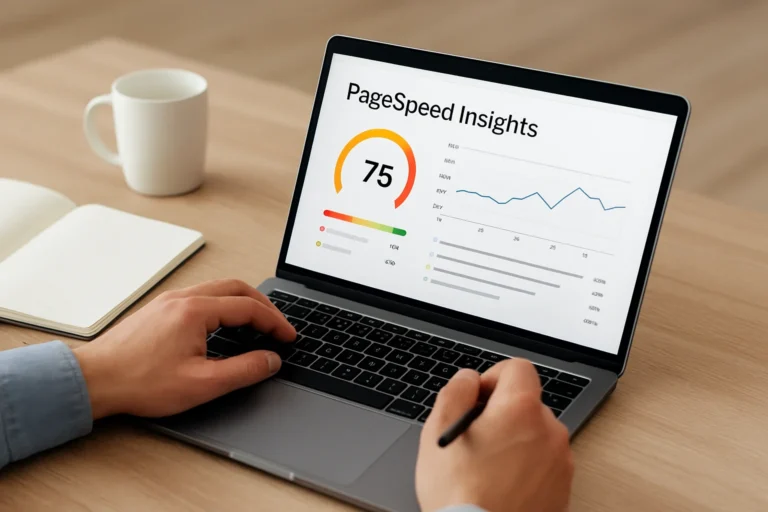
Review site speed, mobile responsiveness, crawlability, indexation, URL structure, internal linking, structured data, and duplicate content. A slow website does not only create a technical problem. It creates a business problem, because visitors leave faster, Google has more difficulty crawling the pages and potential clients may lose trust before contacting the company.
4. Content quality
Product descriptions, category copy, FAQ content, and trust pages should be reviewed. Many e-commerce sites lose visibility because their content is too thin or too similar across pages.
What are the steps of a safe redesign?
A safe redesign follows a sequence. Each step reduces risk and protects revenue.
Step 1: Define business goals
Start with clear priorities. Do you want more sales, better mobile conversion, stronger SEO, or a cleaner catalog structure? The redesign should support measurable goals, not subjective preferences.
Step 2: Map the current site
Create a full inventory of pages, categories, filters, and product templates. This helps identify what must be kept, improved, merged, or redirected.
Step 3: Preserve SEO value
Keep high-performing URLs when possible. If changes are necessary, plan 301 redirects carefully. Do not remove pages that rank without checking their traffic and keyword value.
Step 4: Improve navigation and product discovery
Users should find products quickly. Clear categories, strong filters, visible search, and logical product grouping reduce friction and increase qualified leads for the checkout process.
Step 5: Redesign product and category pages
Product pages should answer buying questions fast: price, delivery, returns, stock, variants, and trust signals. Category pages should guide users and support SEO, not only display products.
Step 6: Test before launch
Test mobile display, checkout flow, forms, tracking, redirects, metadata, and page speed. A launch without testing can damage both revenue and credibility.
Step 7: Monitor after launch
The work does not end at launch. Rankings, conversions, crawl errors, and user behavior must be monitored closely during the first weeks.
Should you redesign, rebuild, or optimize?
Not every e-commerce site needs a full rebuild. Sometimes a focused optimization project is enough. The right choice depends on the current platform, the technical debt, and the business objective.
| Option | Best for | Advantages | Limits |
|---|---|---|---|
| Redesign | Sites with weak UX but a solid technical base | Improves visual clarity, conversion, and mobile experience | Can still carry legacy issues if the structure is not reviewed |
| Rebuild | Sites with major technical limitations or outdated architecture | Allows a cleaner foundation, better performance, and stronger scalability | Higher cost and higher migration risk if poorly managed |
| Optimization | Sites that already perform well but need targeted improvements | Lower cost, faster impact, less disruption | May not solve deeper structural problems |
If the site already has strong traffic, a full rebuild should be justified by real business needs. If the main issue is conversion, a redesign focused on UX and content may be enough.
How do SEO, GEO, and AEO fit into an e-commerce redesign?
SEO, GEO, and AEO should not be added after the design is finished. They should shape the structure from the beginning.
SEO: protect visibility and rankings
SEO ensures that product and category pages remain visible in search engines. This means preserving URLs, improving internal linking, and making sure each page has a clear purpose.
GEO: make the site understandable for AI search systems
GEO is about making the content easy for AI-driven search tools to interpret. Clear headings, direct answers, structured product information, and strong category logic help machines understand what the site sells and who it serves.
AEO: answer buyer questions quickly
AEO focuses on direct answers. Product pages, FAQ sections, shipping details, and trust signals should answer the questions buyers ask before they purchase. This improves both search visibility and conversion.
A strong e-commerce structure also supports other business-focused websites, such as construction company website development or recruitment agency website development, because the same principle applies: the site must be clear enough for both users and search engines to understand the offer quickly.
What is the business impact of a well-managed redesign?
A well-managed redesign can improve revenue without increasing advertising spend. That is the main value.
Better navigation helps users find products faster. Better product pages build trust. Better technical performance improves crawlability and page speed. Better checkout design reduces abandonment. Together, these changes improve commercial performance.
For decision-makers, the benefit is not only a nicer interface. It is a stronger digital asset that supports growth, reduces wasted traffic, and improves conversion over time.
This is why THE ROAD treats redesign as a business project. Chez THE ROAD, l’objectif n’est pas seulement de créer un site web visuellement propre. L’objectif est de construire une présence digitale claire, rapide, crédible et capable de soutenir la croissance de l’entreprise.
What should you avoid during an e-commerce redesign?
Several mistakes can create avoidable losses:
- changing too many things at once without a migration plan
- removing pages that already rank well
- ignoring mobile users
- replacing clear navigation with fashionable but confusing layouts
- launching without redirect mapping
- forgetting tracking and analytics validation
- writing product pages only for design, not for search and conversion
These mistakes usually happen when the project is treated as a visual refresh instead of a full commercial and technical redesign.
FAQ
How long does an e-commerce redesign take?
It depends on the size of the catalog, the platform, and the migration complexity. A focused redesign may take a few weeks, while a full rebuild can take several months.
Will a redesign hurt SEO?
It can, if URLs, redirects, metadata, and content are not managed correctly. With proper planning, a redesign can protect rankings and even improve them.
Should we redesign the whole site or only key pages?
If the main issues are conversion or mobile usability, key pages may be enough. If the architecture is outdated, a broader redesign is usually more effective.
What is the most important page in an e-commerce redesign?
Category pages and product pages usually have the biggest impact. They influence both search visibility and the buying decision.
When should we contact an agency?
Contact an agency when the redesign affects SEO, migration, checkout, or catalog structure. These are not just design tasks. They require technical and business coordination.
Need a redesign that protects sales and improves visibility?
A successful e-commerce redesign is not about changing the interface for the sake of change. It is about building a site that is easier to find, easier to trust, and easier to buy from.
If your store needs a redesign, a migration, or a stronger SEO foundation, THE ROAD can help you plan and execute the project with a clear, professional, and conversion-focused approach.
Vous avez un projet web, une refonte ou un besoin SEO ? THE ROAD peut vous accompagner avec une approche claire, professionnelle et orientée résultats.