When a company manages several brands, locations, or business lines, the website structure becomes a strategic decision, not just a technical one. The wrong setup can create confusion, weaken SEO, and make maintenance more expensive over time.
The real question is not which option is more modern. The real question is which structure gives each brand the right level of visibility, credibility, and commercial performance without creating unnecessary complexity.
Quick answer: which option should you choose?
Choose WordPress Multisite if your brands share the same technical logic, central governance, and a similar content model.
Choose separate websites if each brand has its own positioning, audience, SEO strategy, team, or conversion funnel.
For many businesses, the best choice is not purely technical. It depends on how independent the brands are in practice.
Table of contents
What is WordPress Multisite, and when does it work well?
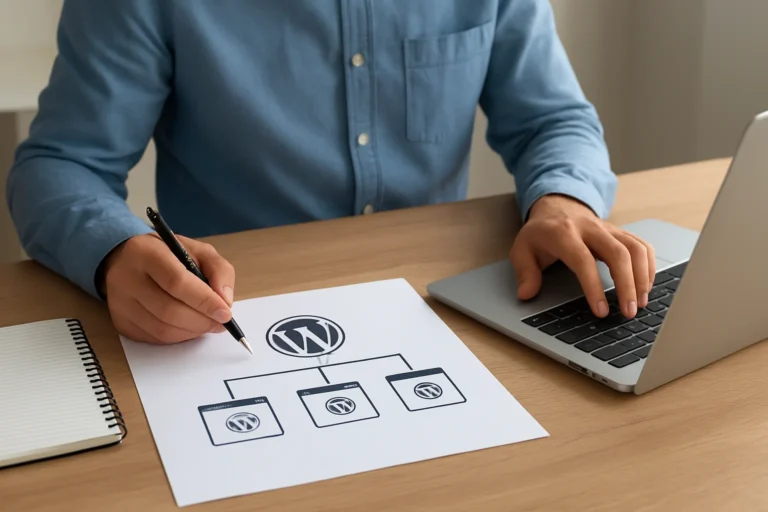
WordPress Multisite is a single WordPress installation that manages multiple websites from one central system. Each site can have its own domain or subdomain, but the technical foundation is shared.
This model works well when the brands are related and the company wants centralized control. It is often useful for groups, franchises, regional branches, educational platforms, or companies managing several controlled web properties.
Typical advantages of Multisite
- One technical environment to maintain
- Centralized updates for core, plugins, and security
- Shared governance across brands
- Lower duplication of technical work
For a business managing a learning platform website development project or a multi-location service network, Multisite can simplify operations if the content and brand logic are aligned.
When do separate websites make more sense for multiple brands?
Separate websites are usually the better choice when each brand has its own market position, tone of voice, target audience, or commercial goal. In that case, forcing everything into one structure often creates more problems than it solves.
This is especially relevant when brands do not share the same SEO strategy or when each one needs a distinct conversion path. A company offering construction company website development for one brand and recruitment agency website development for another may need two very different digital architectures.
Separate websites are often the right choice when:
- Each brand has its own identity and sales process
- SEO targets are different and should not overlap
- Different teams manage the websites independently
- One brand should not affect the reputation or performance of another
- Each business needs its own analytics, content strategy, and conversion funnel
In practice, separate websites give more freedom. They also reduce the risk of one weak brand dragging down the perception of the others.
WordPress Multisite vs separate websites: a practical comparison
| Criteria | WordPress Multisite | Separate websites |
|---|---|---|
| Technical management | Centralized and efficient | More independent, more work |
| Brand flexibility | Moderate | High |
| SEO control | Good if brands are related | Stronger for distinct brands |
| Maintenance | Faster at scale | More time-consuming |
| Risk isolation | Lower | Higher |
| Content governance | Centralized | Decentralized |
| Best for | Groups, franchises, similar sites | Independent brands, different markets |
What does this choice mean for SEO, GEO and AEO?
SEO is not only about ranking pages. It is about building a structure that search engines can understand and trust. GEO and AEO go one step further: they require clear answers, strong topical organization, and content that can be interpreted by AI-driven search systems.
A good structure helps both users and search engines. If your brands are too different, a shared architecture can blur search intent and weaken topical authority. If your brands are closely related, a central structure can reinforce consistency and reduce technical duplication.
For SEO, ask these questions
- Do the brands target the same keywords or very different ones?
- Will pages compete with each other in search results?
- Can each brand build its own topical authority?
- Will internal linking support or confuse the user journey?
For businesses that want to generate qualified leads, the structure must support search intent. If your website needs to rank for multiple service lines, the architecture should make each offer easy to find, easy to understand, and easy to contact.
What is the real business impact of the wrong choice?
A poor website structure does not only create a technical problem. It creates a business problem, because visitors may not understand the offer, Google may struggle to evaluate relevance, and the sales team may receive weaker leads.
The impact usually appears in four areas:
- Visibility: pages compete or fail to rank properly
- Credibility: the brand architecture feels unclear or inconsistent
- Maintenance cost: teams spend more time fixing avoidable issues
- Conversion: visitors do not reach the right offer fast enough
For companies comparing platform decisions, the same logic applies to other projects such as physiotherapist website development tunisia or notaries tunisia what professional. The structure must fit the business model, not just the design preference.
At scale, the wrong choice also affects governance. A central team may lose control over brand quality, or local teams may feel blocked by a system that is too rigid.
How should you decide step by step?
The best decision is usually made by combining business goals, SEO requirements, and operational reality. A technical recommendation without business context is rarely enough.
Step 1: Define the independence of each brand
If each brand has its own audience, offer, and sales process, separate websites are often safer.
Step 2: Map the content and SEO overlap
If the brands share many keywords and topics, Multisite may be efficient. If the overlap is low, separate websites usually create cleaner positioning.
Step 3: Review team structure
If one central team manages everything, Multisite can reduce friction. If different teams need autonomy, separate websites are easier to govern.
Step 4: Evaluate long-term maintenance
Do not only compare launch cost. Compare the cost of updates, security, content production, redesigns, and future growth.
Step 5: Think about conversion paths
Each brand should have a clear path to contact, quote request, or lead generation. If one shared structure makes that path less clear, it is probably the wrong choice.
Where THE ROAD fits into this decision
Chez THE ROAD, the objective is not only to create a website that looks clean. The objective is to build a digital presence that is clear, fast, credible, and capable of supporting business growth.
That means the structure is planned before the design. We look at SEO, GEO, AEO, user experience, technical maintenance, and conversion from the start. For multi-brand businesses, that approach avoids expensive mistakes later.
Whether the right answer is WordPress Multisite or separate websites, the decision should support long-term performance, not just immediate convenience.
FAQ
Is WordPress Multisite better for SEO?
Not automatically. It can work well when the brands are closely related and the content strategy is coherent. If the brands are different, separate websites usually give better SEO control.
Can each site in a Multisite network have its own domain?
Yes. Each site can use its own domain, subdomain, or subdirectory depending on the setup. The technical choice should match the branding and SEO strategy.
Is Multisite cheaper than separate websites?
Often yes at the technical level, because maintenance is centralized. But the real cost depends on governance, content production, and the complexity of each brand.
When should I avoid WordPress Multisite?
Avoid it when brands are too different, when teams need full autonomy, or when you want strong isolation between websites. In those cases, separate sites are safer.
Can THE ROAD help choose the right structure?
Yes. We can assess your brands, content, SEO priorities, and operational needs to recommend the most practical and scalable setup.
Final decision: what should you do next?
The right structure is the one that helps each brand be found, understood, and chosen. If the brands are closely connected, WordPress Multisite can be efficient. If they need strong independence, separate websites are usually the better long-term choice.
If you are planning a new multi-brand website, a redesign, or a migration, the decision should be made before development starts. That is the best way to protect visibility, reduce maintenance risk, and improve conversion.
You have a web project, a redesign, or an SEO need? THE ROAD can support you with a clear, professional approach focused on results.