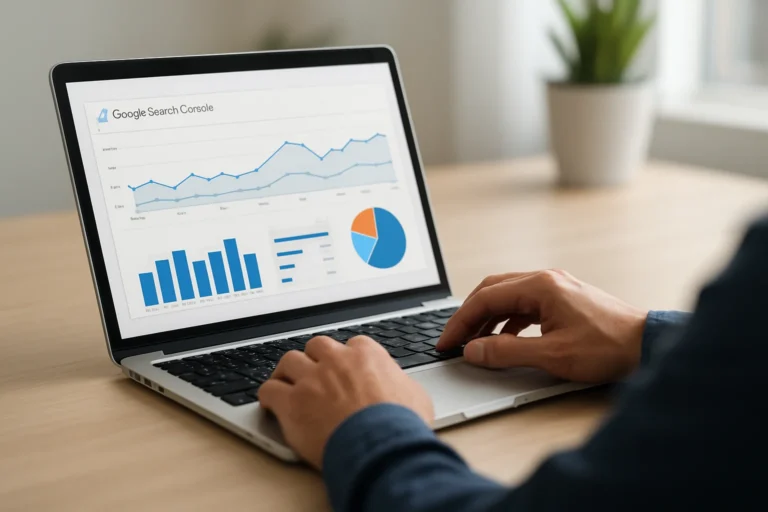
For an e-commerce website in Tunisia, visibility is not only a ranking issue. It is a commercial issue. If your store is not found for the right searches, your traffic stays low, your acquisition costs rise, and your conversion potential remains limited.
The real challenge is not just getting more visitors. The objective is to be found by the right buyers, answer their intent clearly, and give search engines enough structure to trust and recommend your pages.
Direct answer: what do SEO and GEO change for an e-commerce site?
SEO helps your store appear in Google results for product, category, and brand searches. GEO improves your local and market-specific visibility, especially when customers search with location-based intent, regional language cues, or business context.
For an e-commerce business in Tunisia, the combination matters because it supports three things at once: visibility, credibility, and conversion. A well-structured store can attract qualified traffic, reduce dependency on paid ads, and create a stronger long-term acquisition channel.
Table of contents
Why do SEO and GEO matter for e-commerce in Tunisia?
Because e-commerce competition is no longer only about price. Customers compare trust, speed, product clarity, delivery confidence, and search visibility before they buy. If your store does not appear early in the journey, another brand gets the click.
In Tunisia, this is even more important for businesses that sell across cities, regions, or B2B segments. A company offering commerce website development tunisia needs more than a visually correct store. It needs a structure that supports search intent, local discovery, and product relevance.
Search engines also evaluate whether your site is easy to understand. Clear categories, descriptive product pages, internal linking, and strong technical foundations help Google crawl the site efficiently and connect each page to the right query.
What should be optimized first on an e-commerce website?
The first priority is not content volume. It is site architecture. If the structure is weak, content efforts will not perform as well as they should.
| Priority area | Why it matters for SEO | Business impact |
|---|---|---|
| Category structure | Helps search engines understand product families and intent | Improves discoverability and category-level traffic |
| Product page quality | Supports keyword relevance and conversion signals | Increases trust and purchase readiness |
| Technical performance | Improves crawlability, speed, and indexing | Reduces bounce rate and protects conversion |
| Internal linking | Distributes authority across the site | Helps important pages rank better |
| Local signals | Supports GEO and regional search intent | Strengthens local visibility and market trust |
A slow website does not only create a technical problem. It creates a business problem, because visitors leave faster, Google has more difficulty crawling the pages and potential clients may lose trust before contacting the company.
SEO vs GEO: what is the difference for an online store?
SEO focuses on ranking your pages for relevant searches. GEO focuses on making your business visible in a specific geography, market, or local context. For e-commerce, the two should work together.
| Aspect | SEO | GEO |
|---|---|---|
| Main goal | Rank for relevant search queries | Appear for location or market-specific intent |
| Typical pages | Home, category, product, blog, FAQ | Location pages, regional landing pages, local service pages |
| Key signals | Content relevance, backlinks, internal links, technical quality | Business location, service area, regional language, local trust signals |
| Best use case | Broad organic growth | Market penetration and local demand capture |
If your store serves specific cities, regions, or business sectors, GEO can improve how your offer is interpreted by both users and search engines. This is especially useful for brands that also need website development offshore businesses or serve multiple markets with different buying behaviors.
How do you build a strong SEO and GEO foundation step by step?
A good process avoids random content production. It starts with structure, then content, then authority, then measurement.
Step 1: Audit the current site structure
Check how categories, filters, product pages, and informational pages are organized. The objective is simple: be found, be understood and generate contact or purchase.
Step 2: Map search intent to page types
Not every keyword should lead to a blog article. Some searches deserve a category page, others a product page, and some need a guide or comparison page. Matching intent to page type improves conversion and ranking potential.
Step 3: Improve product and category content
Product pages should not only list specifications. They should answer practical questions: who the product is for, what problem it solves, what makes it different, and why the buyer should trust the store.
Category pages should explain the range, not just display products. This helps search engines understand topical relevance and gives users a better decision path.
Step 4: Strengthen technical foundations
Indexation, canonical tags, structured data, mobile performance, and crawl depth all matter. If technical SEO is weak, even strong content may underperform.
Step 5: Add GEO signals where they make sense
Use location pages, local contact details, service areas, and region-specific wording when relevant. This is useful for brands that operate in Tunisia and want stronger local visibility without diluting the main store architecture.
Step 6: Measure commercial outcomes, not only rankings
Track organic revenue, category conversion rate, assisted conversions, and branded search growth. Rankings alone do not tell the full story.
What should e-commerce businesses avoid?
Many stores lose performance because they treat SEO as a content task only. That approach usually creates weak pages, duplicate content, and poor internal structure.
- Do not publish thin product descriptions copied from suppliers.
- Do not create too many pages without a clear search purpose.
- Do not hide important categories behind filters that search engines cannot interpret well.
- Do not launch a store without thinking about crawlability and indexation.
- Do not separate SEO from UX, because both affect conversion.
For sectors with more complex decision cycles, such as industrial supplier website development or transport company website development, the same principle applies: the site must explain the offer clearly and support trust at every step.
How do SEO, GEO and AEO work together on an e-commerce site?
SEO brings visibility in search results. GEO improves relevance for a market or location. AEO helps your content answer questions directly in search features, AI results, and voice-style queries.
For e-commerce, this means product and category pages should be written in a way that is easy to scan, easy to understand, and easy to quote. Clear headings, concise answers, structured FAQs, and descriptive metadata all help.
This is also useful for brands that need generate applications reassure employers or other trust-sensitive digital experiences, because the same logic applies: the page must reduce uncertainty quickly and clearly.
What is the business impact of doing this properly?
A well-optimized e-commerce site usually performs better in three areas.
- Lower acquisition dependency: Organic traffic reduces pressure on paid media.
- Higher trust: Better structure and content make the brand look more credible.
- Better conversion: Visitors find the right product faster and make decisions with less friction.
That is why SEO should not be added after the website is finished. It should be planned from the beginning, especially for stores that want to scale without rebuilding the site later.
How does THE ROAD approach e-commerce SEO and GEO?
Chez THE ROAD, l’objectif n’est pas seulement de créer un site web visuellement propre. L’objectif est de construire une présence digitale claire, rapide, crédible et capable de soutenir la croissance de l’entreprise.
For e-commerce brands in Tunisia, that means aligning structure, content, technical performance, and market positioning from the start. It also means building pages that can rank, convert, and support long-term visibility instead of relying only on short-term campaigns.
Whether the project involves a new store, a redesign, or a more advanced SEO roadmap, the work should always connect search visibility to commercial performance. That is the difference between a website that exists and a website that sells.
FAQ
Is SEO enough for an e-commerce website in Tunisia?
SEO is essential, but it is not enough on its own. The site also needs strong UX, technical performance, and GEO signals if the business serves specific cities or markets.
When should SEO be planned for an online store?
Before development starts. If SEO is added after launch, the site often needs structural changes that cost more time and money. Planning early avoids rework.
What type of pages matter most for e-commerce SEO?
Category pages, product pages, and supporting content such as FAQs or buying guides. These pages capture the highest commercial intent and support conversion.
Does GEO matter for stores that sell nationally?
Yes, especially if buyers search by city, region, or service area. GEO helps the store appear more relevant to local demand and market-specific intent.
Can THE ROAD help with a new store or a redesign?
Yes. THE ROAD supports website creation, SEO, GEO, refonte, and maintenance with a business-focused approach designed to improve visibility and conversion.
Ready to improve your e-commerce visibility?
If your store needs stronger organic traffic, better local visibility, or a more credible structure for buyers and search engines, the next step is a clear audit and a practical roadmap.
You have a web project, a redesign, or an SEO need? THE ROAD can support you with a clear, professional, and results-oriented approach.