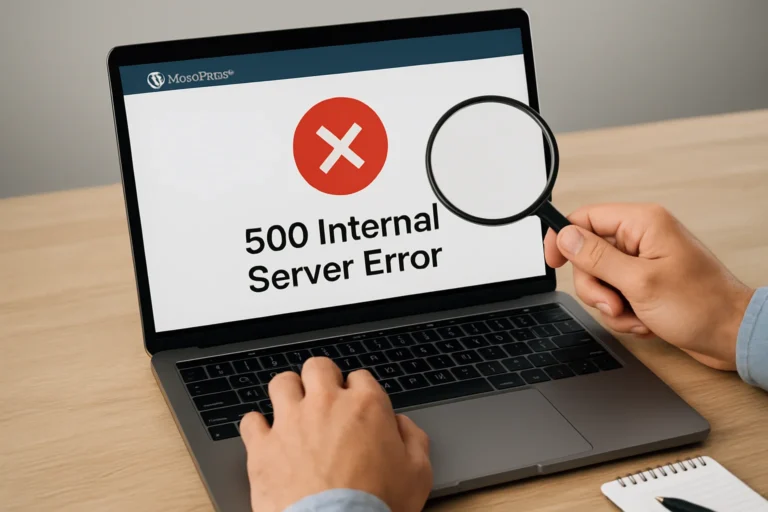
A hacked WordPress website is not only a security issue. It is a business interruption. Visitors may see spam, Google may flag the site, and your team may lose qualified leads while the problem remains active.
The real challenge is not just removing malicious files. The objective is to restore a clean technical foundation, protect your search visibility, and make sure the attack does not come back through the same weak point.
Direct answer: what should you do first?
If your WordPress site has been hacked, the first priority is to isolate the damage, secure access, and identify how the attacker entered the site. Do not start by deleting random files. That often removes symptoms, not the cause.
The safest approach is to back up the infected site for analysis, put the website in maintenance mode if needed, reset all credentials, scan core files, themes, plugins, and database content, then restore only what is clean and necessary.
Table of contents
Why do WordPress websites get hacked?
Most attacks do not happen because WordPress is weak by design. They happen because the website is outdated, poorly maintained, or built with unnecessary risk. A site with old plugins, weak passwords, abandoned themes, or insecure hosting becomes an easy target.
In many cases, the attacker does not need to break the whole system. One vulnerable plugin, one stolen admin password, or one infected file is enough to inject spam pages, redirect traffic, or create hidden links that damage search performance.
This is why WordPress maintenance is not a technical luxury. It is part of protecting revenue, reputation, and customer trust.
What are the real business risks of a hacked site?
A hacked site creates several problems at the same time. The design may still look normal on the surface, but the business impact can be serious.
| Problem | Business impact |
|---|---|
| Spam pages or hidden links | Search engines may reduce trust and visibility |
| Redirects to suspicious sites | Visitors leave immediately and brand credibility drops |
| Malware warnings | Qualified leads stop contacting the company |
| Defaced content | The company appears unreliable or inactive |
| Blacklisting by browsers or Google | Traffic and conversion can fall sharply |
A slow or infected website does not only create a technical problem. It creates a commercial problem, because visitors leave faster, Google has more difficulty crawling the pages, and potential clients may lose trust before contacting the company.
How do you clean a hacked WordPress website step by step?
1. Contain the attack
Start by limiting access. Change admin passwords, hosting passwords, database credentials, and FTP or SSH access. If multiple users have access, review every account and remove anything unnecessary.
2. Take a full backup for analysis
Even if the site is infected, keep a full copy before making changes. This helps identify the entry point, understand the payload, and avoid losing important content or evidence.
3. Scan core files, themes, plugins, and uploads
Compare WordPress core files with a clean version. Check themes and plugins for injected code, suspicious PHP files, and unexpected modifications. The uploads folder is also a common hiding place for malicious scripts.
4. Clean the database
Hackers often inject spam links, fake pages, or hidden scripts into the database. Cleaning only the files is not enough if the database still contains malicious content.
5. Reinstall trusted components
Replace compromised plugins, themes, and core files with fresh copies from reliable sources. Remove anything abandoned, unnecessary, or unsupported.
6. Review SEO and indexing issues
Check whether spam pages were indexed, whether redirects were created, and whether Search Console shows security warnings. This step matters because the attack may continue to affect visibility even after the site looks clean.
7. Harden the site after cleanup
Once the site is clean, add stronger security controls, update everything, and monitor logs. A cleanup without prevention is incomplete.
How does a hacked website affect SEO, GEO, and AEO?
Search engines need trust, consistency, and a clean structure. A hacked site breaks all three. If Google detects spam, cloaking, or suspicious redirects, rankings can drop quickly. In some cases, pages disappear from search results until the issue is resolved.
For GEO and AEO, the problem is also structural. AI search systems and answer engines rely on clear content, stable pages, and trustworthy signals. If the site is compromised, the content becomes harder to interpret and less likely to be cited or surfaced.
A clean website is not only safer. It is easier to crawl, easier to understand, and more likely to support long-term SEO.
For businesses investing in learning platform website development, construction company website development, psychologist website development tunisia, recruitment agency website development, or website development air conditioning, security should be planned from the start. A site that is built to grow must also be built to survive attacks.
When should you call a professional agency?
You should contact a professional agency as soon as the hack affects access, content integrity, indexing, or customer trust. If the website is generating leads, selling services, or supporting brand credibility, time matters.
Professional help is especially important when the attack is not obvious, when multiple sites are hosted on the same server, or when the business needs to recover fast without breaking SEO.
At THE ROAD, the objective is not only to clean the site. The objective is to restore a digital presence that is clear, fast, credible, and able to support growth. That includes the technical cleanup, the SEO impact, and the long-term maintenance needed to avoid a repeat incident.
How do you prevent another WordPress hack?
Prevention is usually simpler and cheaper than recovery. A secure WordPress setup should include regular updates, strong authentication, limited admin access, backups, malware monitoring, and a hosting environment that is properly configured.
| Prevention action | Why it matters for the business |
|---|---|
| Regular updates | Reduces exposure to known vulnerabilities |
| Strong passwords and 2FA | Makes unauthorized access harder |
| Role-based access | Limits damage if one account is compromised |
| Daily backups | Speeds up recovery after an incident |
| Security monitoring | Detects attacks before they affect customers |
| Maintenance plan | Keeps the site stable, secure, and searchable |
If your website supports sales, lead generation, or local visibility in Tunisia, maintenance should be treated as part of commercial performance, not as an optional extra.
What should companies avoid after a hack?
There are a few common mistakes that make recovery slower and more expensive.
- Deleting files without identifying the source of the attack
- Keeping old plugins that are no longer maintained
- Restoring a backup without checking whether it is also infected
- Ignoring Search Console warnings or browser alerts
- Leaving admin access unchanged after the cleanup
These shortcuts often create a second incident. A proper cleanup should fix the cause, not only the visible damage.
FAQ
Can I clean a hacked WordPress site myself?
Yes, but only if you know how to inspect files, database content, and server logs safely. If the site is business-critical, a professional cleanup is usually faster and less risky.
Will my SEO recover after the hack?
It can recover if the site is fully cleaned, security issues are fixed, and search engines are informed that the problem is resolved. Recovery is faster when the cleanup is complete and the site stays stable.
Should I delete all plugins after a hack?
No. Remove only the compromised or unnecessary ones. Reinstall trusted plugins from clean sources and review whether each one is really needed for the business.
How long does a WordPress cleanup take?
It depends on the size of the site, the severity of the infection, and whether the database is affected. A simple case may take hours, while a deeper compromise can take longer.
Can a hacked website affect customer trust even if the homepage looks normal?
Yes. Hidden spam pages, redirects, or security warnings may not be visible to you immediately, but visitors and search engines can still detect them. That is enough to damage trust.
Need a clean recovery plan for your WordPress site?
A hacked website should be treated as a business issue, not only a technical incident. The faster you clean it, secure it, and fix the weak points, the faster you protect visibility, credibility, and conversion.
Vous avez un projet web, une refonte ou un besoin SEO ? THE ROAD peut vous accompagner avec une approche claire, professionnelle et orientée résultats.