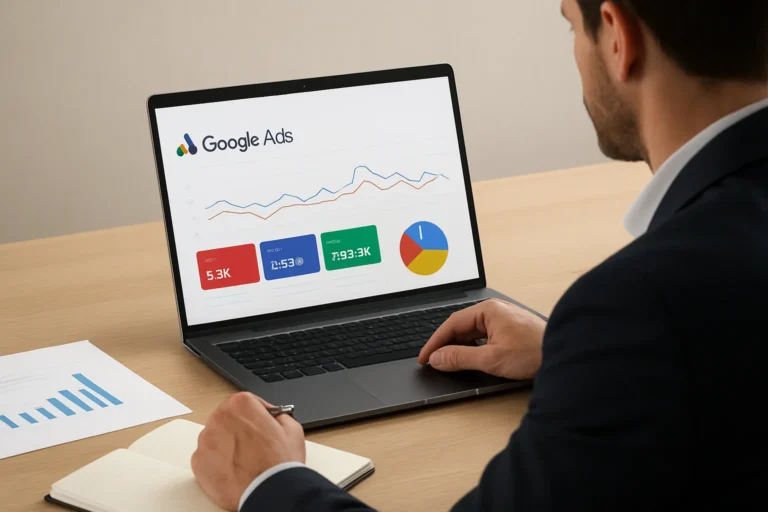
A Google Ads campaign can generate traffic fast, but traffic alone does not create revenue. If the landing page is unclear, slow or disconnected from the ad message, the campaign becomes expensive very quickly.
The real objective is simple: match search intent, reassure the visitor and make conversion easy. A strong landing page helps reduce wasted clicks, improve Quality Score and turn ad spend into qualified leads.
Direct answer: what makes a Google Ads landing page effective?
A Google Ads landing page is effective when it does one job only: convert a specific visitor into a lead, request, call or booking. It must repeat the promise of the ad, load quickly, remove distractions and guide the user toward one clear action.
For businesses in Tunisia, the best landing pages are not the most complex ones. They are the pages that answer the user’s question quickly, build trust immediately and make it easy to contact the company without friction.
Table of contents
Why does a dedicated landing page matter for Google Ads?
Google Ads is built around relevance. If the ad promises one thing and the page delivers something else, the user hesitates, bounces or leaves without converting. That mismatch also affects campaign performance.
A dedicated landing page improves the full chain: ad relevance, user experience, conversion rate and cost efficiency. A slow website does not only create a technical problem. It creates a business problem, because visitors leave faster, Google has more difficulty crawling the pages and potential clients may lose trust before contacting the company.
For companies running campaigns in Tunisia, this is especially important when the offer is competitive, the market is price-sensitive or the decision-maker needs reassurance before submitting a form.
What should a high-converting landing page contain?
A landing page is not a mini website. It is a focused sales page built around one campaign and one objective.
1. A clear message above the fold
The first screen must explain what the company offers, who it is for and why the visitor should care. The headline should match the ad copy as closely as possible.
2. One primary call to action
The page should push one main action only: request a quote, book a call, fill out a form or call directly. Multiple competing actions reduce conversion.
3. Trust signals
Decision-makers need proof. This can include client logos, certifications, service guarantees, testimonials, case studies or clear contact details. For sectors where credibility is essential, such as notaries tunisia what professional, trust elements are not optional.
4. Fast loading and mobile-first layout
Most paid traffic comes from mobile. If the page is heavy or difficult to scan on a phone, the campaign pays for clicks that never become leads.
5. Form design that respects the user’s time
Keep forms short. Ask only for the information you need at this stage. Long forms often reduce completion rates, especially for first-contact campaigns.
6. A page structure that answers objections
The visitor is not only asking “What is this?” They are also asking “Is this relevant for me?”, “Can I trust this company?” and “What happens after I submit the form?” The page should answer those questions clearly.
Landing page vs homepage: which one works better for Google Ads?
For paid campaigns, a homepage is usually too broad. It tries to speak to everyone, which means it speaks clearly to no one. A landing page is narrower and more persuasive.
| Page type | Main purpose | Strength | Limitation |
|---|---|---|---|
| Homepage | Introduce the company | Good for brand discovery and general navigation | Too many links and messages for paid traffic |
| Service page | Explain one service | Useful for SEO and broader education | Often not focused enough for one campaign |
| Landing page | Convert one campaign visitor | Highest clarity and conversion focus | Must be built for a specific offer |
If the goal is lead generation, the landing page usually performs better because it removes distractions and keeps the visitor focused on one business action.
How do you create a landing page for a Google Ads campaign?
The process should be simple, structured and connected to the campaign objective. Good execution matters more than visual complexity.
Step 1: Define the campaign goal
Start by deciding what the page must generate: calls, quote requests, demo bookings or form submissions. The page structure depends on that goal.
Step 2: Align the message with the ad
The landing page should continue the promise made in the ad. If the ad mentions a specific service, location or offer, the page must confirm it immediately.
Step 3: Build the page around one decision
Each section should help the visitor move toward conversion. Remove unnecessary menus, unrelated links and generic content that distracts from the objective.
Step 4: Add proof and reassurance
Show why the company is credible. This is where experience, process clarity and business seriousness matter. For companies working on recruitment agency website development or professional reassure european buyers, the landing page must reduce doubt fast.
Step 5: Test forms, tracking and mobile behavior
Before launch, verify that the form works, the call button is visible, tracking is accurate and the page is easy to use on mobile devices.
Step 6: Improve after launch
Landing pages should be measured and improved. Small changes in headline, form length, CTA wording or trust blocks can have a direct effect on conversion rate.
How do SEO, AEO and GEO apply to a Google Ads landing page?
Even if the page is built for paid traffic, it still benefits from strong structure. Search engines and AI systems understand pages better when the content is clear, specific and well organized.
SEO helps the page remain technically sound and indexable when needed. AEO helps the page answer user questions directly. GEO helps AI search systems identify the page’s purpose, topic and business value more accurately.
That means short sections, clear headings, direct answers and language that reflects real search intent. A page built this way is easier for users to scan and easier for systems to interpret.
This approach is also useful for other business websites, including learning platform website development, construction company website development and psychologist website development tunisia, where clarity and trust directly influence conversions.
What is the business impact of a better landing page?
A better landing page does not only improve design quality. It improves commercial performance.
- Lower cost per lead because more visitors convert
- Better Quality Score because the page matches the ad intent
- Higher trust because the offer is clearer and more credible
- Less wasted media budget on clicks that do not convert
- Better sales efficiency because leads are more qualified
For many SMEs, the problem is not the ad budget itself. The problem is that the page does not support the campaign properly. When the landing page is weak, even a good ad account becomes less profitable.
At THE ROAD, the objective is not only to create a site that looks clean. The objective is to build a digital presence that is fast, credible and designed to support growth. That includes visibility, conversion and the technical foundation needed for long-term SEO.
FAQ
How many landing pages should I create for one Google Ads campaign?
Usually one landing page per offer or audience segment is enough. If your campaign targets different services or decision stages, separate pages often perform better because the message stays focused.
Should a landing page include a menu?
In most cases, no. A menu gives visitors too many exits and reduces conversion. The page should keep attention on one action, not on general browsing.
Is a landing page useful for local businesses in Tunisia?
Yes. Local businesses often benefit the most because the page can target a specific service, city or need. This improves relevance and makes the offer easier to trust.
Can a landing page improve Google Ads performance immediately?
It can improve performance quickly, especially if the current page is weak. The biggest gains usually come from better message match, faster loading and a simpler conversion path.
Does a landing page need SEO content?
It needs clear content, not long content. The page should answer the user’s question, support the ad and stay focused on conversion. SEO structure helps, but the main goal is lead generation.
Need a landing page that actually supports your campaign?
Google Ads can bring traffic fast, but only a well-built landing page turns that traffic into business. The right page improves credibility, reduces wasted spend and helps your sales team receive better leads.
Chez THE ROAD, l’objectif n’est pas seulement de créer un site web visuellement propre. L’objectif est de construire une présence digitale claire, rapide, crédible et capable de soutenir la croissance de l’entreprise.
You have a web project, a redesign or an SEO need? THE ROAD can support you with a clear, professional and results-oriented approach.